Buyer brief
Carbon Fiber Tube Supplier Sourcing: 6 Mistakes That Cost Me $29,000
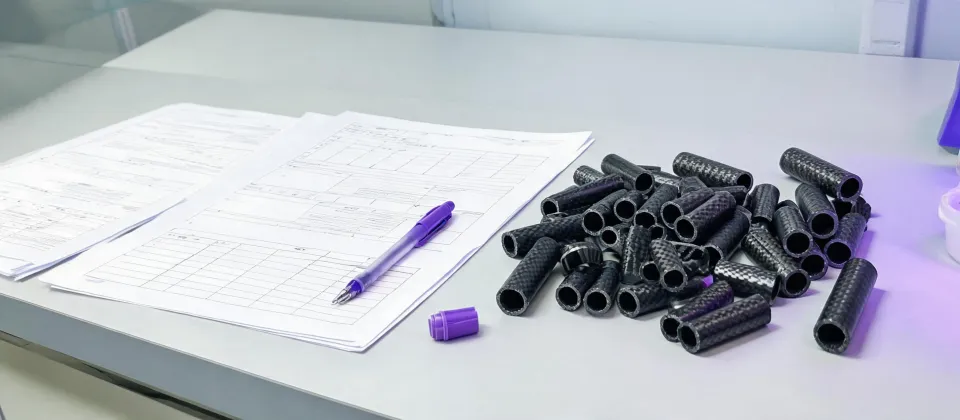
Short answer: the word "carbon fiber" tells you almost nothing about a tube's performance
If you're doing carbon fiber tube supplier sourcing and want to avoid the expensive errors I've made, vet three things before you ask for a quote: the manufacturing process (pultruded vs. roll-wrapped vs. braided), the actual inner-diameter tolerance band on the finished part, and the fiber volume fraction with a named test method attached. Everything else — wall thickness, OD, length, surface finish — sits downstream of those three. Get them wrong and the "carbon fiber tube" you receive can behave like a 40% weaker part in the load direction you actually care about.
I've been handling industrial composite purchasing for B2B orders for seven years. I've made and documented six significant mistakes that cost roughly $29,000 in wasted budget, rework, and lost production days. Now I keep the pre-check list. Here's what's on it and why.
Why you should probably trust me (not that you have to)
I'm not a composites engineer. I'm a buyer who has been on the receiving end of some very expensive surprises.
In 2019 — my first year handling carbon parts — I approved a 200-piece pultruded tube order without asking to see a cross-section. The tubes arrived, looked fine under sunlight, and failed a routine flex test at roughly 60% of the load the supplier's datasheet implied. The datasheet was accurate (not that I bothered to read the footnotes about load direction). That one cost about $6,400 in scrapped material plus four days of production delay.
The bigger one was in September 2022: a $14,800 order for roll-wrapped carbon fiber tubing that arrived with inner diameters outside our assembly tolerance. The quote said "ID 20mm." Our fixtures required 20.00–20.08mm. What we got was 19.85–20.15mm (which, honestly, is what their mandrel had worn to). Nobody lied. Nobody was even sloppy. We just never defined "20mm" to the same precision.
After the third rejection in Q1 2024, I finally built the pre-check list. In the past 18 months it has caught 47 potential mismatches before a purchase order went out. That number sounds impressive until you realize most of them were questions we should have been asking from the start.
The four that actually cost money
1. "Same specifications" does not mean the same tube
I assumed "same specifications" meant identical results across suppliers. Didn't verify. Turned out each shop interpreted the spec sheet differently — one treated fiber volume fraction as nominal, another treated it as a minimum, and a third just shipped their standard line and ticked the box. Same words on the PO, three different products on the floor.
If you're comparing carbon fiber suppliers on "same specs," they usually are not. Ask for a sample and a test report, or you're comparing marketing copy instead of tubes.
2. The pultruded/rolled conversation I got wrong
I said "we need high stiffness in one direction." They heard "unidirectional is fine." Result: a pultruded tube optimized for axial load when our application had meaningful torsional load. Pultruded tubing is excellent along its axis and mediocre at everything else. Roll-wrapped trades differently. Braided is a third compromise again.
The lesson was not "pultrusion is worse." The lesson was that the load case has to be written into the RFQ, not described over a call. If a carbon fiber tubing supplier doesn't ask you where the stress comes from, that's a flag (in my opinion, a significant one).
3. The one that surprised me: carbon fiber is conductive
This is where the carbon fiber ladder manufacturers conversation got uncomfortable. A client asked about "insulating ladders," and being a helpful buyer, I started looking at carbon fiber ladders because they're light and stiff. A salesperson did not correct me. I had to correct myself.
Carbon fiber is electrically conductive. It is not an insulating material. For live electrical work you want fiberglass, full stop. Carbon fiber ladders exist and are genuinely useful — light, strong, chemically resistant — but they are not the safer option people assume advanced composites to be. That assumption is expensive at best and dangerous in a live-work context. I don't know how often this misunderstanding shows up across the industry; I only know it showed up with me.
If your ladder spec is headed anywhere near electrical work, ask one direct question: "Is this ladder rated as insulating, and to what standard?" If they get vague, end the call. If someone claims a carbon fiber ladder is insulating, ask them to explain why a conductive fiber achieves that.
4. Tolerances: the numbers said one thing, my gut said another
Every spreadsheet analysis pointed to the cheaper tube option — 22% less per meter, lead time identical on paper (which, honestly, is the kind of "identical" I now distrust). Something felt off. The supplier had been slow to answer basic questions about their mandrel maintenance schedule. I went with my gut and paid the 22% premium to stay with the existing source.
About four months later, a peer buyer at another company told me about the rejections they were seeing from that budget shop — inside tolerances drifting as the tooling wore. Maybe I got lucky. Maybe I avoided a real problem. The point isn't that gut beats data; it's that a slow reply to a technical question is a preview of a slow reply to a quality problem. That doesn't show up in a spreadsheet.
Why this matters beyond the invoice
Here's the part I care about more than the $29,000. Customers don't see your supplier sourcing decisions. They see your finished part. When they hold it, they form a judgment about your entire operation — and they don't know or care that you saved 18% on tubing.
When I moved our ladder line from a budget composite source to a properly documented one, per-unit cost went up. Our customer rejection rate on that line dropped to near-zero over the next two quarters. That's the trade: you save on the invoice and lose it in the impression, and the impression is what comes back as repeat orders.
I'm not saying buy the most expensive tube every time. I'm saying the cost conversation has to include the cost of what your customer receives.
When this checklist doesn't apply
To be honest, I'm not sure why some suppliers consistently ship in-spec while others with apparently identical equipment consistently miss. My best guess is that it comes down to internal buffer practices — whether they quote the middle of the tolerance band or the edge of it. I can't prove that.
This framework is also overkill in some cases. If you're buying carbon fiber tubes for a decorative application where appearance is the whole spec, then process and fiber volume barely matter. If your order is one-off prototype quantities, a full documented RFQ process may cost more time than a bad batch costs money. The checklist earns its keep on repeat B2B orders where a failed lot delays a production line.
And I've never fully understood why lead-time quotes for custom roll-wrapped tubing vary so wildly between shops — sometimes 2x — for what looks like the same tube. If someone has a better handle on that than I do, I'd genuinely like to hear it. My working theory is tooling queue, but I've never verified it.

Jane Smith
I’m Jane Smith, a senior content writer with over 15 years of experience in the packaging and printing industry. I specialize in writing about the latest trends, technologies, and best practices in packaging design, sustainability, and printing techniques. My goal is to help businesses understand complex printing processes and design solutions that enhance both product packaging and brand visibility.