Buyer brief
Carbon Fiber Tube Supplier Sourcing: Direct Factory vs. Sourcing Service
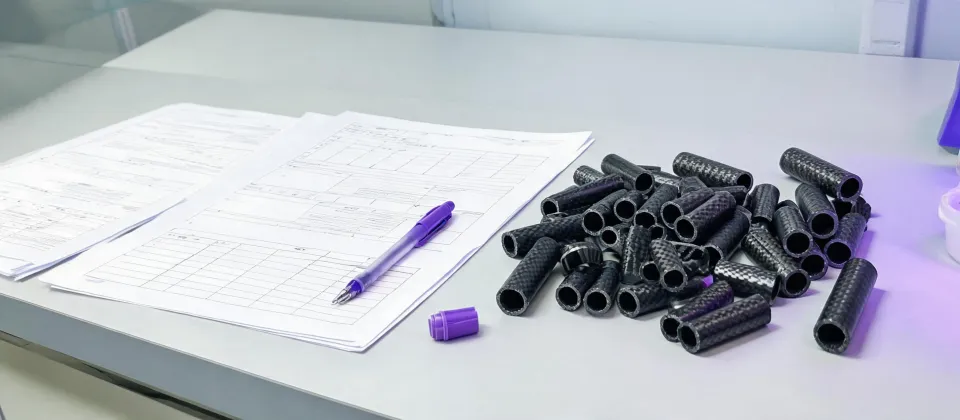
Carbon Fiber Tube Supplier Sourcing: Direct Factory vs. Sourcing Service
I'm the quality and brand compliance manager at an industrial equipment company. I review roughly 200 items a year, and in 2024 I rejected about 11% of first deliveries due to spec mismatches. For the past four years we've sourced carbon fiber tubes two ways: direct from manufacturers, and through sourcing service providers. I won't pretend one way is universally better. What I want to show is where each approach actually performs better—and why.
The comparison below covers four dimensions: product range, quality consistency, real total cost, and problem-solving. I'll use specific numbers where I have them.
Dimension 1: Product Range and Specialist Depth
A direct carbon fiber tube supplier that focuses on tubes usually does one thing well. One pultrusion factory we worked with ran 90% of its machine time on a single wall thickness—they knew that process window cold. But they didn't make carbon fiber ladders, plates, or custom fittings.
Sourcing service providers typically cover more ground. That's their whole value proposition. They can handle carbon fiber tubes, plates, and ladder assemblies in one order. We had a project that needed 2,000 tubes plus 40 ladder assemblies bundled together—a single factory simply couldn't do that combination.
Here's what surprised me: broad coverage doesn't automatically mean shallow depth. One sourcing service we used cross-verifies every outgoing tube batch. They don't run a pultrusion line themselves—but they back up quality with independent test data. That beats the factory that just verbally assured us their material was "100% carbon fiber." The difference, in our experience, is whether the carbon fiber tubing suppliers you work with provide their own spec sheets from independent testing, or just forward the factory's certificates.
Dimension 2: Quality Consistency and Documentation
Batch consistency from a direct factory comes from fixed processes. If the line is stable, batch-to-batch variation is usually small. The catch—you're depending on their own inspection reports. Not every pultrusion plant has an ISO 17025-calibrated lab. Most of the ones we've worked with don't.
Going through a service provider means a longer traceability chain, which theoretically adds a review layer. How well that works depends on how seriously they take it. We once got a batch with 0.3mm outer diameter deviation against our 0.15mm tolerance—the "review layer" had just forwarded the factory's paperwork. The factory called it "within industry standard." We rejected the batch, and they redid it at their cost. Now every contract includes a requirement for third-party dimensional verification against the delivery spec, regardless of which sourcing path we choose.
One rule of thumb for evaluating carbon fiber suppliers: if they can't quantify performance against ASTM D3039 or an equivalent standard, they're just talking. Ask for specific numbers.
Dimension 3: Total Cost Structure—Not Just Unit Price
Direct factory unit prices are usually lower. That's real. But treating unit price as total cost is a classic oversimplification. The gap (typically 8–15%) gets eaten up by verification costs: third-party testing at about $400 per batch, plus rework labor and schedule delays if the batch fails.
Here's the part that's counterintuitive: people think expensive suppliers deliver better quality. Actually, suppliers who deliver consistent quality can charge more. The causation runs the other way. We ran a blind test in 2023—mixed tubes from two suppliers, had six engineers do surface and dimensional checks, and four of them identified the 40%-more-expensive samples as "clearly more professional." The visual difference was negligible. The real difference was roundness and wall uniformity, which they only caught after measurement. That test changed our incoming inspection criteria: roundness is now a mandatory check. The premium paid for measurably better consistency, not perception.
Dimension 4: Responsiveness and Problem-Solving
Direct factories usually respond faster. You talk to the technical lead or the production manager directly, and issues get discussed on the spot. But their technical depth often stops at what they make. Beyond that, you get "that's not our scope."
Sourcing service providers have longer communication chains and slower initial responses. But one thing changed my view: when disputes come up, a good sourcing service acts as a neutral third party. One time, a factory insisted a dimensional deviation was "a measurement method difference." The sourcing service paid out of pocket to send a sample to an independent lab for a same-standard ruling—and the factory ultimately admitted the process issue. Without that middle layer, we'd have been arguing with the factory for weeks. I don't know exactly what they absorbed on that, but from our side, paying a premium for a middleman that leans toward technical judgment—rather than the factory—was worth it.
I'm not a materials scientist, so I can't speak to resin systems or fiber sizing choices. That's a question for someone with composites engineering background. From a procurement and quality control perspective, though, the four dimensions above are what we evaluate.
Choosing Between the Two Approaches
Based on our experience over the last few years:
- Go direct if your needs concentrate on a single tube specification, your team understands the material, you have engineering depth to write tight specs, and you have a reliable third-party testing channel. You'll save on unit price and get faster responses.
- Go through a sourcing service if your demand spans tubes, carbon fiber ladder assemblies from various carbon fiber ladder manufacturers, and other profiles—especially non-standard items. It saves the hassle of multiple contacts, contracts, and delivery schedules. The prerequisite: verify whether their review is real, or just document forwarding.
- If delivery certainty matters more than price, prioritize providers willing to supply third-party test reports and batch traceability. Our current approach keeps direct purchasing for long-term single-spec relationships and routes multi-category projects through sourcing services. There's no universal answer—it comes down to whether you can independently handle spec review and quality verification.
The pricing and testing figures here were accurate as of Q1 2025. The carbon fiber raw material market moves fast, so verify current quotes before budgeting.

Jane Smith
I’m Jane Smith, a senior content writer with over 15 years of experience in the packaging and printing industry. I specialize in writing about the latest trends, technologies, and best practices in packaging design, sustainability, and printing techniques. My goal is to help businesses understand complex printing processes and design solutions that enhance both product packaging and brand visibility.